In the beginning, founder-led go-to-market is both a necessity and a massive benefit. It's how you learn, and it's how you land the lighthouse customers that make everything after them possible. But what happens when the business outgrows the benefit?
Picture a founder at $1–5M ARR. They close every real deal themselves. They write every post, every one-pager, every piece of content that converts. They talk to a reporter or an analyst and get taken seriously. Things are going well, so they hire an AE, or a first marketing leader — the textbook next move. Then close rates, message quality, and everything else drop at the same time. Everybody's frustrated, so the founder jumps back in to save the deal, the interview, the web content, the whatever. Soon the frustration spirals into blame and something has to change.
This is a greatest hit for cyber startups experiencing early success. Except it's not a hit. It's also eminently avoidable — but only if the founder embraces a critical mindset change about their role.
This is mostly a systems problem, not a people problem.
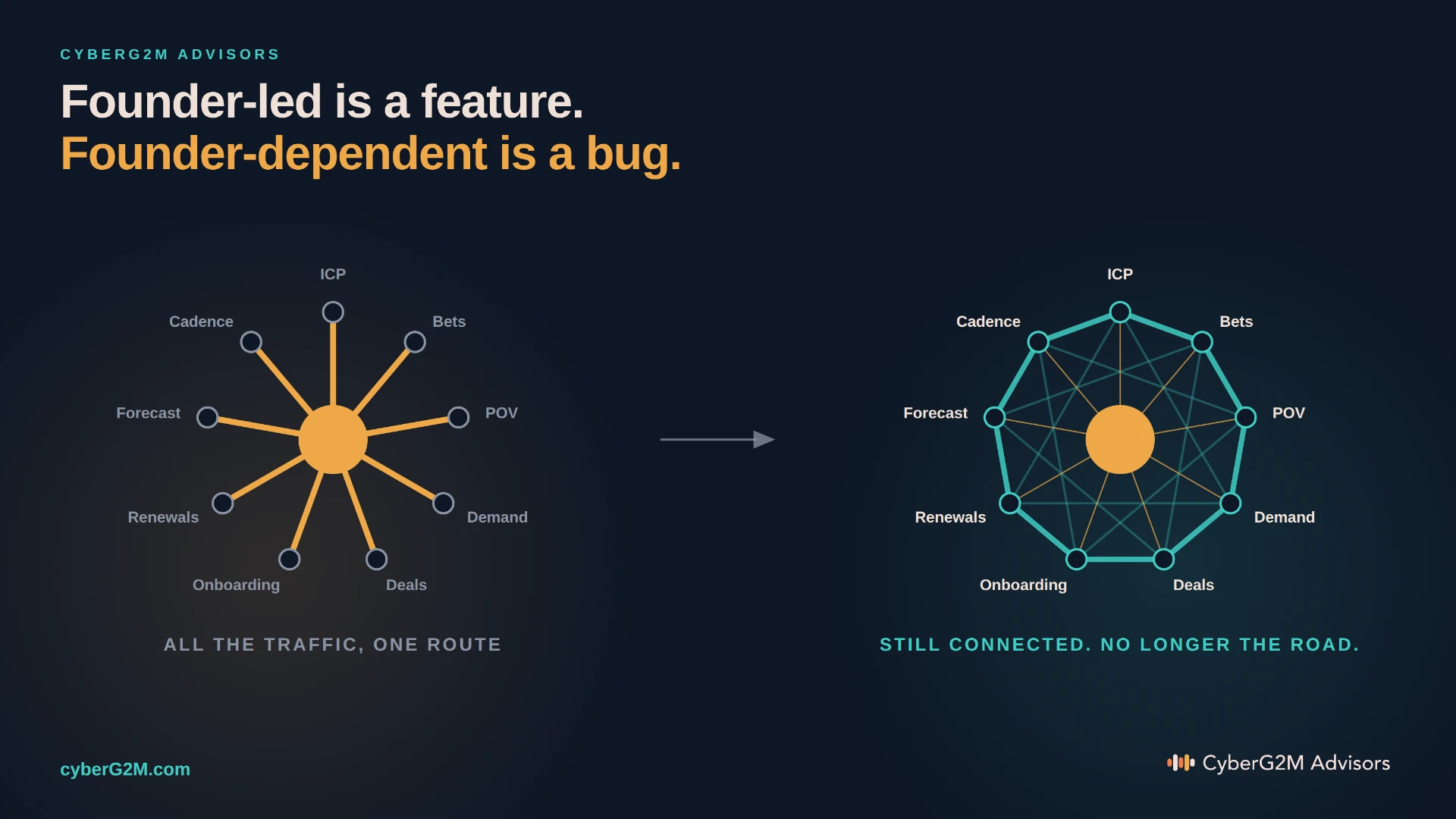
The standard answer is right — and incomplete
Jason Lemkin gives the sharpest version of the common advice. Founder-led sales, he writes, "generally stops scaling around $1m-$2m ARR" — and the tell is that founders are watching the wrong number. "The MRR/ARR keeps growing, because you are still adding bookings and customers. But the % growth rate begins to decay as the absolute bookings growth slows way down."1
His sequence is specific: one or two scrappy AEs early, after you've personally closed "the first 10-20 customers, minimum," then a first VP of Sales around $1–1.5M ARR, once two reps are consistently hitting quota.2 He's just as sharp on marketing, having hired his own VP of Marketing at $20K MRR.3 Spot on, all of it — and he names a precondition most people quoting him skip: close the first ten or twenty yourself, stay in the trenches, refine the pitch.
Here's where I'd push.
Look at what he expects the hire to do — a great VP of Sales "will come in and if nothing else, take whatever leads you have … and get more out of them."1 Founders read that as permission. Hit the number, make the hire, and the thing you've been doing personally just gets more hands on it.
Bad assumption.
Closing the first twenty yourself proves personal repeatability. It says nothing about whether anyone else can run it. Those are different tests, and the second one is the gate that matters: whether the thing that makes your deals close has been made explicit enough to hand to somebody. You can hit every one of Lemkin's marks and be nowhere near it. In cyber that gap is wider, because a lot of what's closing the deal is the founder's technical credibility — the demonstrated fact that they understand this buyer's problem better than the buyer's own team does. That's real. It's also the part everyone assumes can't be transferred.
Here's what that looks like in practice. A founder hires a VP of Sales at $2M ARR. Six months later, the close rate is off a cliff. Their read: wrong hire. The real problem sits upstream of the hire: nobody had ever pinned down what made deals close, so whoever got hired, in whatever order, was guessing.
Scaling an ever-changing hunch ICP isn't scaling. It's failing faster, with more people and a bigger burn rate.
Neither sales nor marketing can replicate the founder's instincts on their own. You need a deliberate transfer of both the knowledge and the responsibility.
The harder part: watching someone do it worse
Founders don't struggle to hire. What they struggle with is watching someone else market or sell their product — worse to begin with — without stepping back in.
It goes like this:
- A new sales hire flubs a pitch. The founder jumps back in "just this once," closes the deal themselves, and feels vindicated. What they proved is the opposite of what they think: the system doesn't have to work, because they'll always be there to save it. And it teaches learned helplessness — the rep stops using their own judgment, because why bother?
- A marketer drafts the launch post. The founder reads it at 11 pm, decides it's not landing, and rewrites half of it in their own voice before it ships. The marketer stops pitching bold ideas after that. Whatever they write is getting overwritten anyway, so why bother?
I'm guilty of this myself. From my CMO chair, I too often handed a BDR, a digital marketer, or a PR firm something I'd explained once and expected market-ready copy back — as if they could summon twenty years of industry context from a single briefing. They usually couldn't. And I got frustrated with them, not with myself. It was always my job to transfer that knowledge, and I hadn't done it.
Here are the stakes: a company that grows only as fast as its founder's calendar has a ceiling. That has obvious financial implications, and it also keeps the founder away from critical strategic work — long-term product strategy, recruiting, team alignment. And there are fundraising consequences. As my friend David Politis — multi-time founder and CEO coach — put it to me: "Investors don't want to invest in a company that relies on the founder to do all the deals."
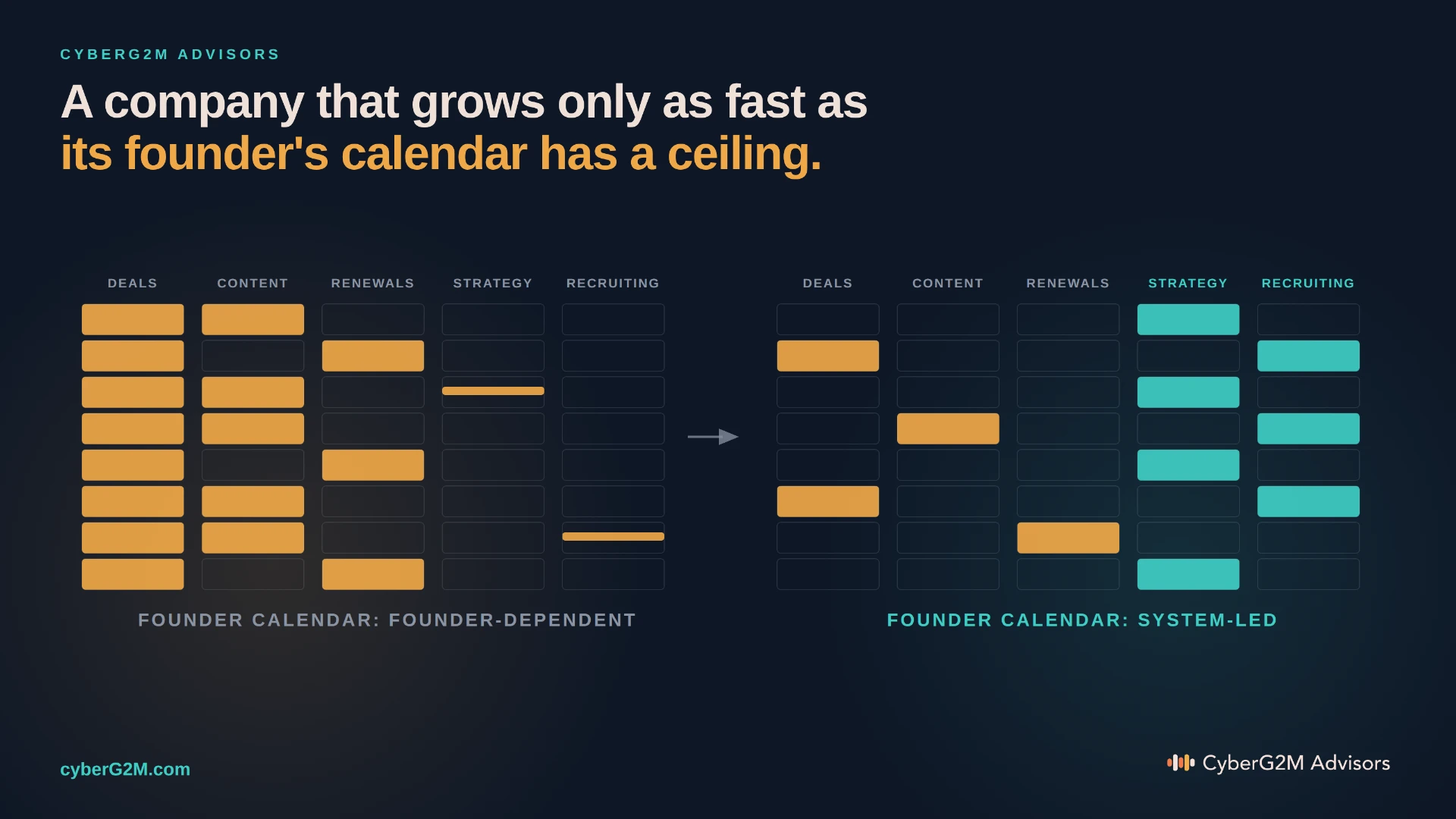
So founder-led has to become system-led, and the founder's job has to move from doing all the things to building the system that does them. It's a different job. Ironically, it's well suited to technical founders who are natural system thinkers.
Nine places founder dependency hides
Founders are overwhelmed. That's part of the gig. But a big chunk of that overwhelm is founder dependency, and it gets lost in the sauce of general busy-ness.
| Founder-dependent | System-led | What you still own | |
|---|---|---|---|
| Who we sell to | You know it when you see it. The list lives in your head and moves per deal. | A scored, finite account list built on the characteristics that actually predicted a close. | The anti-ICP. Who we walk away from stays a founder call, permanently. |
| Where we place our bets | You decide what to chase deal by deal, usually in the room. | Named segments and priced packages, each with a stated bet and a number behind it. | The bet itself. Which market, which wedge, what we refuse to build. |
| What we stand for | The POV is your POV. Analysts and reporters want you, and only you. | A company POV a customer can repeat and a reporter can quote with someone else's name on it. | The origin story, the keynote, the analyst relationship. Yours for years. |
| How buyers find us | Your network, your LinkedIn, your last job's Rolodex. | Two or three motions that produce pipeline on a schedule, with owners who aren't you. | Showing up. You at the right dinner is still the best hour this company spends. |
| How deals get worked | Your instinct in real time. Criteria unstated, objections handled fresh every time. | Named objection patterns, explicit qualification criteria, stage definitions anyone can apply. | Five strategic deals, picked at the start of the quarter. |
| How customers get to value | You personally make the first ten deployments work. Nights and weekends included. | An onboarding play, a time-to-value target, a documented ROI story per customer type. | The escalation that deserves a founder. There will be three or four every year. |
| How accounts grow | Renewal is a relationship you hold. Expansion happens when you remember to ask. | Named expansion plays, retention measured by cohort, an owner with a quota attached. | Executive sponsorship on the accounts that define the category. |
| What we know to be true | The CRM is a compliance exercise. The real pipeline is in your head and a spreadsheet you don't share. | One system, one number, one definition of a qualified deal. The forecast survives you leaving the room. | Nothing. This one transfers completely, and the sooner the better. |
| How the team stays aligned | You are the coordination mechanism. Information moves when you're in the room. | A weekly G2M hour: shared dashboard, hard questions, decisions written down. | Running the room, virtual or not. This job never leaves. |
Who we sell to
- Founder-dependent
- You know it when you see it. The list lives in your head and moves per deal.
- System-led
- A scored, finite account list built on the characteristics that actually predicted a close.
- What you still own
- The anti-ICP. Who we walk away from stays a founder call, permanently.
Where we place our bets
- Founder-dependent
- You decide what to chase deal by deal, usually in the room.
- System-led
- Named segments and priced packages, each with a stated bet and a number behind it.
- What you still own
- The bet itself. Which market, which wedge, what we refuse to build.
What we stand for
- Founder-dependent
- The POV is your POV. Analysts and reporters want you, and only you.
- System-led
- A company POV a customer can repeat and a reporter can quote with someone else's name on it.
- What you still own
- The origin story, the keynote, the analyst relationship. Yours for years.
How buyers find us
- Founder-dependent
- Your network, your LinkedIn, your last job's Rolodex.
- System-led
- Two or three motions that produce pipeline on a schedule, with owners who aren't you.
- What you still own
- Showing up. You at the right dinner is still the best hour this company spends.
How deals get worked
- Founder-dependent
- Your instinct in real time. Criteria unstated, objections handled fresh every time.
- System-led
- Named objection patterns, explicit qualification criteria, stage definitions anyone can apply.
- What you still own
- Five strategic deals, picked at the start of the quarter.
How customers get to value
- Founder-dependent
- You personally make the first ten deployments work. Nights and weekends included.
- System-led
- An onboarding play, a time-to-value target, a documented ROI story per customer type.
- What you still own
- The escalation that deserves a founder. There will be three or four every year.
How accounts grow
- Founder-dependent
- Renewal is a relationship you hold. Expansion happens when you remember to ask.
- System-led
- Named expansion plays, retention measured by cohort, an owner with a quota attached.
- What you still own
- Executive sponsorship on the accounts that define the category.
What we know to be true
- Founder-dependent
- The CRM is a compliance exercise. The real pipeline is in your head and a spreadsheet you don't share.
- System-led
- One system, one number, one definition of a qualified deal. The forecast survives you leaving the room.
- What you still own
- Nothing. This one transfers completely, and the sooner the better.
How the team stays aligned
- Founder-dependent
- You are the coordination mechanism. Information moves when you're in the room.
- System-led
- A weekly G2M hour: shared dashboard, hard questions, decisions written down.
- What you still own
- Running the room, virtual or not. This job never leaves.
The founder's job is always to work on the business. The hard part is deciding where you still work in it. That's the third column — and it's a different job than the one you're likely doing now.
And by the way, a booth at RSA is not an event-led motion. A reseller agreement is not partner-led growth. It becomes a motion when it has strategy, ownership, investment, execution, and measurement behind it. Many of the founder-dependent companies in cyber believe they have three motions; they have three tactics the founder personally staffs.
The playbook: before, during, and after
Sales and marketing show up in every phase, because both were the founder's job the whole time.
| Beforeproblem/market fit | Duringthe transition | Afterit took | |
|---|---|---|---|
| Your job | Close every deal, write every post, run the feedback loop yourself | Document, coach, test — then get out of the room | Work on the business. Show up where you're irreplaceable |
| What you're building | Signal. Evidence the thesis holds for more than a few buyers | The system: ICP, message, plays, cadence, one source of truth | Compounding growth that doesn't route through you |
| What good looks like | Deals close because it's you. That's the point | Your team closes worse for a quarter, then better | A new hire closes on the documented ICP alone |
| The trap | Mistaking the phase for an identity | “Just this once” | Taking it back when a quarter gets tight |
Your job
- Before
- Close every deal, write every post, run the feedback loop yourself
- During
- Document, coach, test — then get out of the room
- After
- Work on the business. Show up where you're irreplaceable
What you're building
- Before
- Signal. Evidence the thesis holds for more than a few buyers
- During
- The system: ICP, message, plays, cadence, one source of truth
- After
- Compounding growth that doesn't route through you
What good looks like
- Before
- Deals close because it's you. That's the point
- During
- Your team closes worse for a quarter, then better
- After
- A new hire closes on the documented ICP alone
The trap
- Before
- Mistaking the phase for an identity
- During
- “Just this once”
- After
- Taking it back when a quarter gets tight
Column one is the right setup for the stage. It's a phase. It's supposed to end.
During: the transition — from "doer" to "coach" and "system builder"
The problem comes when you need pipeline beyond the circle of people you already know. Every day you put off building the system is a day of G2M debt, and the hole gets deeper.
In the room, it sounds like this:
That last line should sting. It's why a mindful transition is so critical.
Start with a partial list to document, train, enable, and test on:
- The ICP you've closed or progressed, not the pitch deck version
- The company origin story and the founder's "why"
- The "why it matters" to the industry story
- The target personas and what lands with them messaging-wise
- The real competitive differentiation
- The deals you've lost, and why
- The value your early customers have seen, and how they got it
Build this with sales and marketing together, and do the ICP first — wring out as much ambiguity as you can. Your job is making sure they can run the customer conversation or the campaign without you in the room. The first few go-arounds won't be perfect. Coach anyway.
Let go, deliberately.
Decide in advance what founder involvement still looks like: real exceptions, like the biggest deals, the hardest objections, the signature keynote, not a default fallback. Expect a dip during ramp-up. That's the system being tested, so hold your breath and your emotions. Struggle in the direction of letting more go.
How to tell a slow ramp from a bad hire
The harder question is what you're watching while you wait.
Win rate won't tell you. With a six-to-nine month cycle and a security review in the middle, two quarters is maybe a dozen closed opportunities. That's noise, and founders fire people on it.
So pick what you're watching before the ramp starts:
- Meetings set in ICP. Sounds basic. The second half is what carries it — a rep can fill a calendar with people who'll never buy and look productive doing it. In-ICP meetings with real buyers and influencers are the earliest activity that predicts anything.
- Late-stage pipeline in ICP by the end of the second operating quarter. It doesn't have to be closed, and it doesn't have to be millions, though both would be nice. What you're looking for is progression — deals moving through stages on their own logic, with your name off the thread.
- How they sound on the recordings. After a quarter in the field, pull the calls you weren't on. Nervous, hedging, overpromising to fill the silence? Or asking good questions and answering the hard ones without flinching? In cyber the overpromise is the expensive one — it survives the call and dies at the POC.
- What your SEs say. They know first. Same calls, no quota riding on the answer, and they can tell inside a few meetings whether someone can carry a technical conversation. Ask them after the first several calls you're not on.
- The quality of what comes back from the field. The best signal on this list. A rep who returns asking for a feature list or twenty new pieces of collateral is handing the problem back to you. A rep who returns with something specific about the buyer — a persona you had wrong, a value prop that lands harder than the one on your site — is absorbing what took you five years to learn.
- Your own hours per deal. Cut in half by the end of the second quarter, or nothing is transferring, whatever the revenue says.
If most of these miss, you have a hiring problem after all. That's allowed. Check the system first, then check the person. Set them after the fact and they're just a story you tell yourself about why you were right.
Simpler than any dashboard: if the founder disappeared for a month, would the next ten deals still close? Would the marketing engine still run? Would the next three renewals come in?
Letting go is hard. But necessary. Do it right.
Letting go is effing hard. I don't want to make light of that.
The founder who built their company by doing everything themselves did exactly what the stage required.
The only mistake is not knowing when that stage ended.
1. Jason Lemkin, "Why Founder-Led Sales Breaks Earlier Than You Think," SaaStr.
2. Jason Lemkin, "From 0 to $10m ARR, At What Point Do We Start Hiring and Whom?," SaaStr.
3. Jason Lemkin, "I Hired My VP of Marketing at $20k MRR. It Wasn't a Week Too Early," SaaStr, January 30, 2021.