A pencil factory that wants more pencils to sell doesn't just order more lead and wood. Its managers look at the whole manufacturing process. They work on yield: more output from every set of inputs. Somehow that logic disappears the moment the inputs are leads. Revenue is a two-term equation: inputs times yield.
That's why the "we just need more at the top of the funnel" conversation makes me effin' crazy. I've heard it in pipeline reviews, G2M leadership syncs, and board meetings.
It's not wrong. It's just not complete. And it's lazy thinking.
Like the pencil factory, our B2B revenue funnel is a process. Leads in, revenue out.
So sure, we must talk about getting more qualified leads in. But if we don't also talk about optimizing conversion rates, we're having the wrong conversation. (ASP is a lever too — one that deserves its own post.)
Let's look at the math:
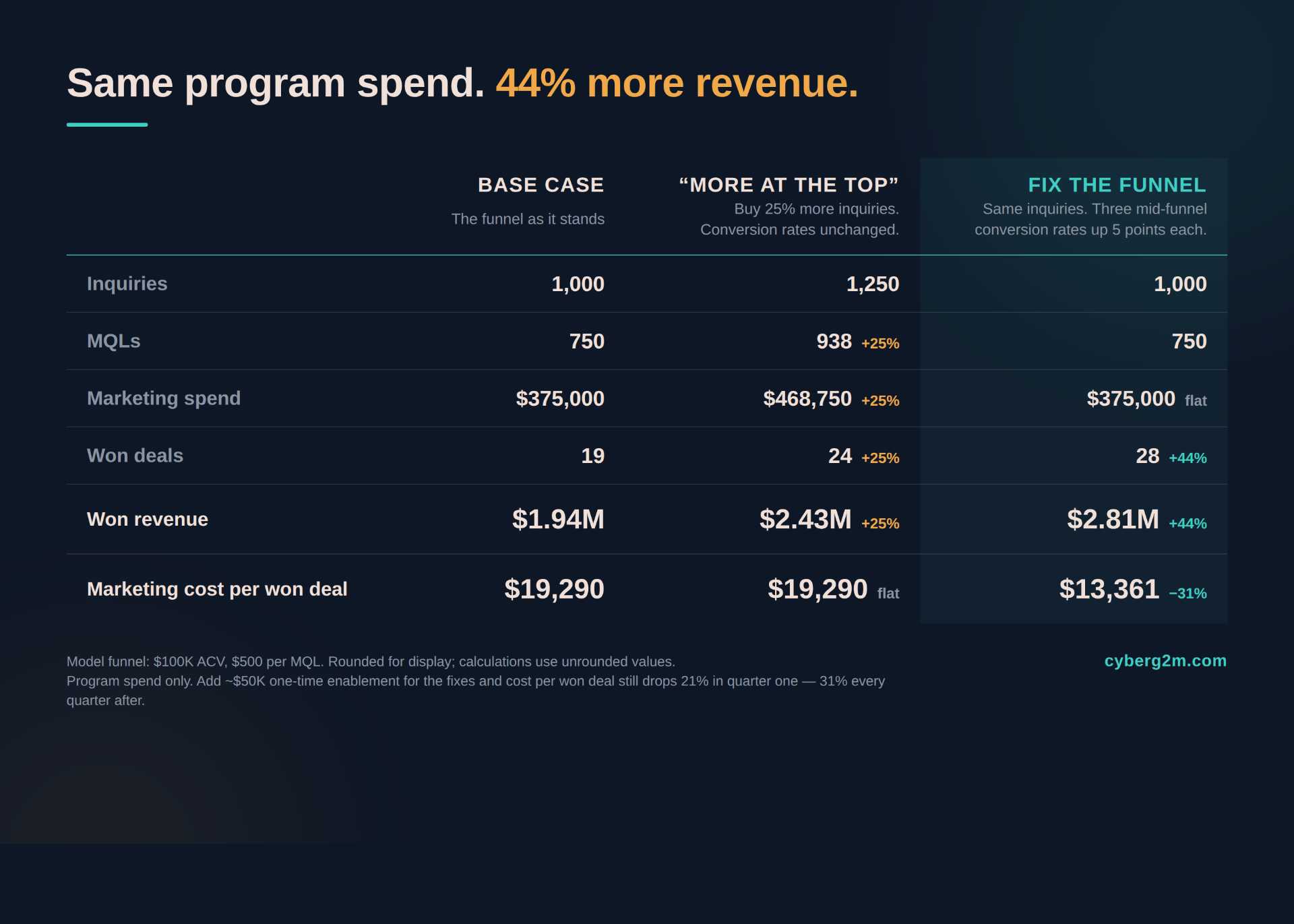
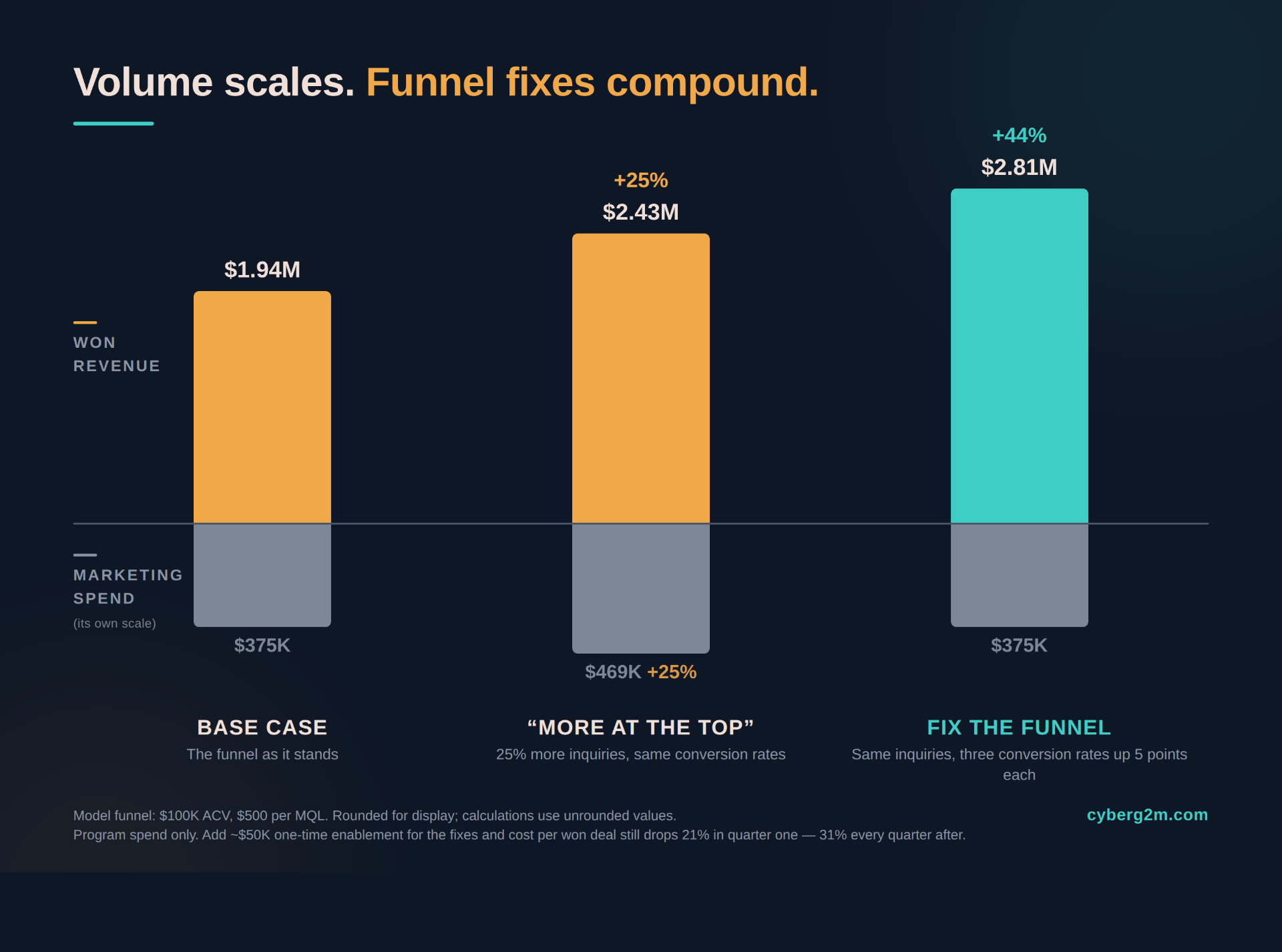
Here's a model funnel for a cyber company: 1,000 inquiries a quarter, typical stage-to-stage conversion rates, $100K ACV, $500 per MQL. The funnel as it stands produces 19 won deals and $1.94M in revenue on $375K of program spend.
Two ways to grow it.
Buy more inputs. Add 25% more inquiries; hold every conversion rate flat. Everything downstream moves in lockstep: 24 wins, $2.43M. So does spend: $468,750. Cost per won deal doesn't budge: $19,290 before, $19,290 after. More revenue, same economics.
Raise the yield. Same 1,000 inquiries. Same $375K. Lift three mid-funnel conversion rates — SQL-to-demo, demo-to-POC, POC-to-negotiation — by five points each. 28 wins, $2.81M, and cost per won deal drops 31% to $13,361.
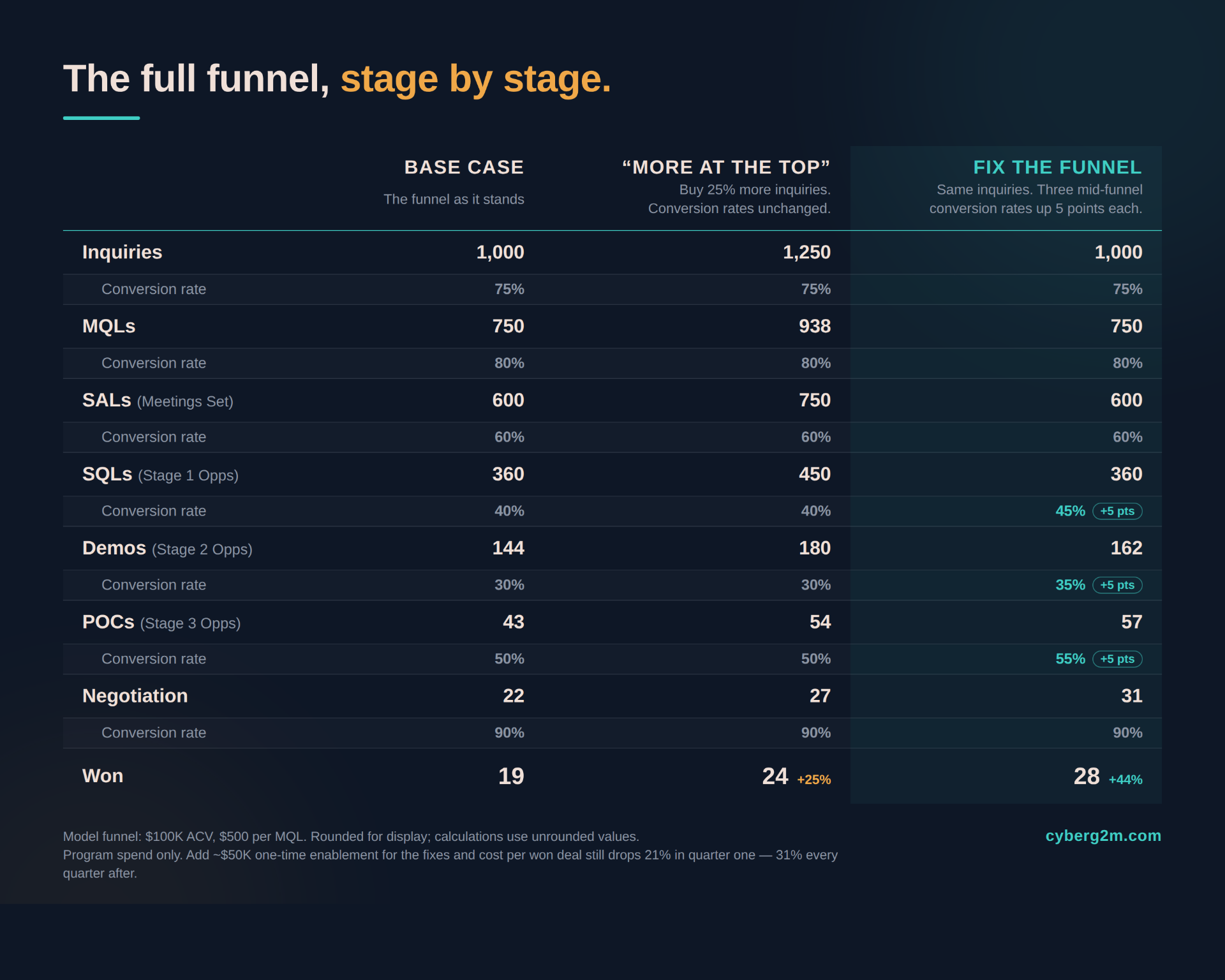
Same program spend. 44% more revenue. And the yield improvements compound: a 12.5% lift times a 16.7% lift times a 10% lift multiplies out to 44%. Inputs are linear. Every incremental MQL costs the same $500 and leaks through the same holes.
And $500 is generous: incremental MQLs get pricier as audiences saturate. And the temptation when you need more MQLs (and don't get me started on MQLs) is just to "manufacture" more — i.e., less qualified.
Back to yield. Reasonable pushback: optimizing three stages at once is too ambitious. Fine. Improve POC-to-negotiation 10 percentage points — this by itself drives revenue up 20% without a new program dollar.
A 50% POC-to-negotiation rate isn't a law of physics. It's friction — fuzzy qualification, no champion built, POCs without agreed-upon exit criteria. And POCs deserve the hardest look. They're the most expensive stage in the building: SE hours, often Product or Engineering pulled in. This is hard work too, which is why it often goes unfixed while everyone argues about lead volume.
The fair pushback: yield work isn't free, and it takes a quarter or two to land while bought volume hits pipeline now. True. But the two investments aren't the same kind. Call the enablement/optimization work $50,000. It's durable: build the qualification framework and POC exit criteria once; they pay dividends on every deal after. Net of that $50K, cost per won deal still drops 21% in quarter one — and the full 31% every quarter after. On the flip side, the incremental MQLs cost $93,750 a quarter, forever. Not to mention — getting in the mode of buying your way into more pipeline every quarter is a bad habit.
So yes: of course we want more at the top. More qualified leads, always. But what we really want is both — more inputs and better yield. Conversion rates get left out of the equation way too often, along with the hard, cross-functional work it takes to improve them. This is the work that separates G2M motions that drag from those that compound.
Don't take my word for it. Run your own numbers with the model — make a copy of the Google Sheet and do your worst. Let me know what you come up with.
Order more lead and wood if you like. But know that once the yield is fixed, every input you buy is worth more.