Founders ask me about how to know if their marketing is working. Often it all sounds like BS and obfuscation. Metrics feel squishy and non-linear. And it's often difficult to draw a bright line to revenue or strategy.
They're spending real money, so they reasonably want to know the return on their investment.
Not surprisingly, I have thoughts. So I was excited when Gianna Whitver asked me to come to New York to speak to a group of cyber founders about marketing measurement. I'm sharing the takeaways here.
But first, three overarching principles:
Now the rules:
Gold's Eight Rules for Measuring Marketing
Measure to the mission — never the activity.
Founders see their marketers are busy. The question is whether the activities they're busy with are the right ones for the mission. If your strategy calls for penetrating SOC teams at the biggest banks in New York, it's not sufficient to hold a webinar (activity), or even to have lots of attendees (too vague). We want to measure how many SOC team members from our target accounts registered or attended.
Definitions matter.
"Qualified meeting." "SQL." "Pipeline." Everyone in the G2M function needs to agree on exactly what each term means — not roughly, exactly. Write the definitions down. Keep them current. Put them on every table and chart you share. Otherwise, you'll waste time discussing what something means, or, worse, you'll miss important signals.
Shared metrics drive alignment.
Sales and Marketing will always have their own metrics. But the big picture business metrics — for instance, meetings set with target personas in ICP accounts, new SQLs, new pipeline generated, pipeline coverage for next quarter — are all shared metrics. It's harder to fight over a number with a clear definition that is owned by both parties.
Don't confuse an operating metric with a business metric.
Campaign performance, email open and click-through rates, newsletter subscribers — these are marketing operating metrics. They tell marketers where to sharpen their own game. Opportunities generated, new pipeline created, pipeline coverage — these are business metrics. They're what goes to the exec staff and the board. Mix the two up and marketing loses the room — nobody on the leadership team cares about your open rate.
Every attribution model is wrong — so stop fighting over credit and evaluate instead.
In 25+ years marketing to the enterprise, I've never seen a buying process that wasn't complex — multiple people, dozens of marketing and sales touches, much of it invisible to any single-touch or lead-based model. For instance, 94% of buying groups pick a preferred vendor before they ever talk to a seller, and that vendor wins roughly 80% of the time1 — research your attribution model will never see, because the buyer (or their AI agent) did it silently.
Treat attribution as a signal, not a verdict, and stop letting sales and marketing fight over who gets credit for a touch — that fight is credit culture, and credit culture kills G2M. Where you can't attribute, evaluate instead: self-reported source, target-account engagement, shortlist rate, branded search. It won't be precise, but it'll be enough to steer the ship — and it keeps both teams focused on the big shared metrics instead of a credit war neither side can win.
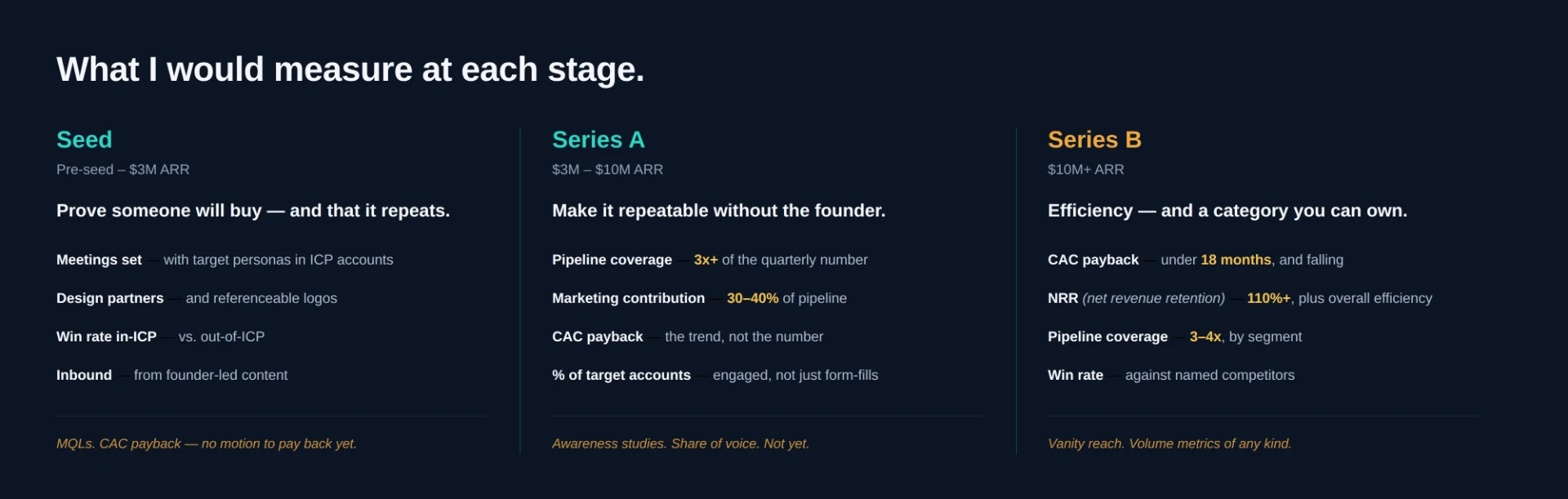
Map the metric to the stage you're in.
The things you measure early are different than the things you measure when you're scaling. Early on, you're looking to validate that your message resonates and that your ICP and target personas are on point. Later, you're trying to build efficiency. Managing to the wrong metric for your stage isn't imprecise — it's actively harmful. Here are some suggestions on what to measure at each stage.
Never share a number without context.
"We had 20 SQLs last month" is meaningless on its own. Was it 12 the month before, or 30? Was the goal 8 or 25? Attach a trend, a goal, or a benchmark to every number you report, or don't bother reporting it.
Metrics without discussion are useless.
A dashboard nobody talks about is decoration. The moment you've hired anyone into G2M, install a weekly cadence to review the northstar metrics: the CEO, your marketing leader (or your one marketer), and your sales leader (or your one seller). Make it mandatory, ensure it's action-oriented, and push for absolute candor. That's how you find and address problems and opportunities early.
Where to Start
Properly instrumenting your marketing engine can be a significant effort. The most important thing is to just start working on it. Here are three things you can do right now that will get you pointed in the right direction.
Agree on Your Northstars
At the business level, agree on what metrics you need to track to see if your strategy is working. It might be meetings with ICP accounts, new pipeline generated, or opportunities generated for a new product. Whatever it is, make sure it tells you whether you're headed in the right direction as a business.
Document Definitions
Every metric in G2M should have an agreed-upon and specific definition. There should be zero ambiguity.
Force Objectives for Every Program Investment
Agree upfront why you're doing every single marketing program you're investing in. Then decide how you'll measure it before it kicks off.
I could talk, or write, a lot more about the importance of funnel measurement. It drives everything from alignment to culture to efficiency and results. If you're wrestling with measurement questions, let's talk. Find time at www.schedulegold.com.
¹ 6sense, 2025 B2B Buyer Experience Report: 94% of buying groups rank their vendor shortlist before ever engaging a seller, and roughly 80% of deals go to that early favorite. 6sense.com